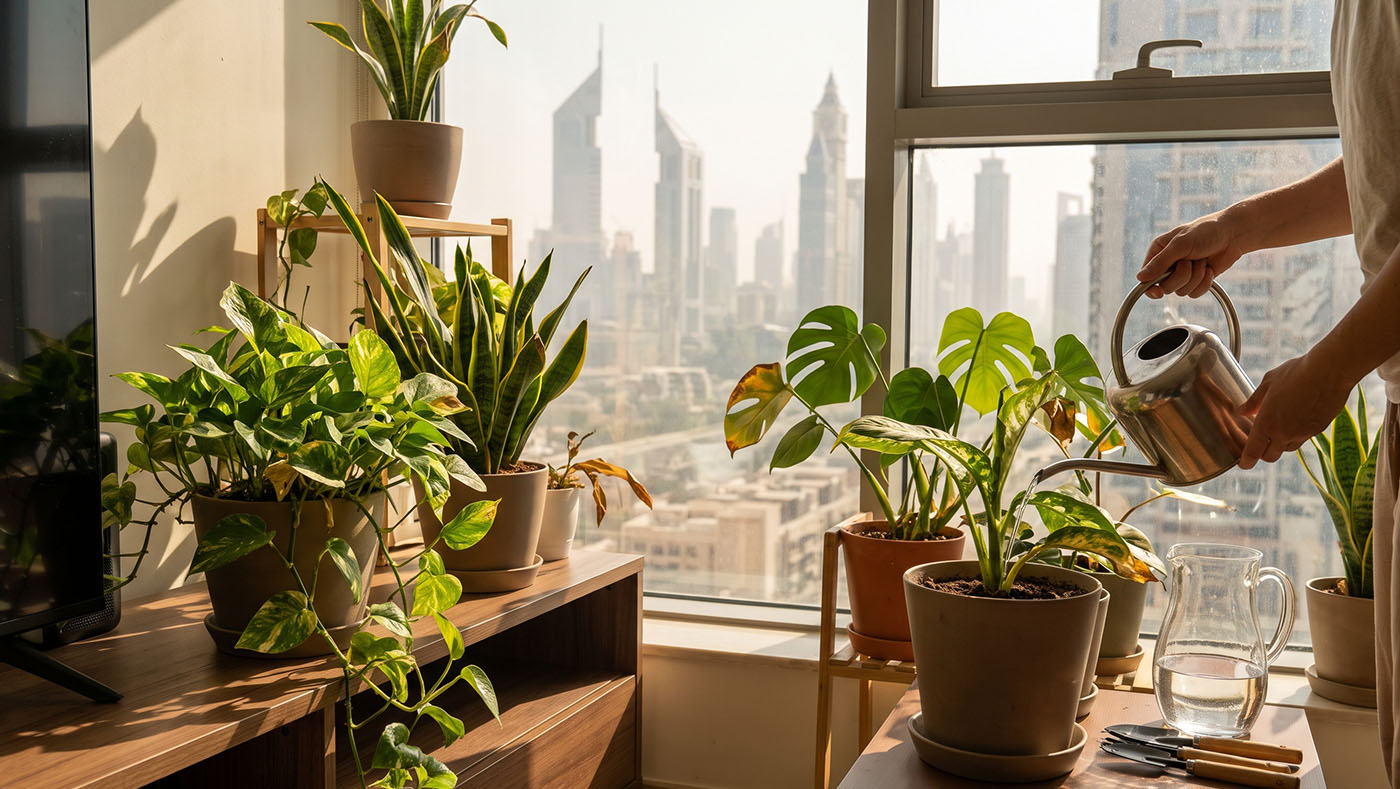
Dubai is characterized by beautiful indoor forests; whether it’s the green monstera shrub in living rooms or the chic peace lilies on working desks, making an appropriate ambiance for indoor horticulture.
However, caring for indoor plants in the UAE prompts a question many owners often ask themselves; can Dubai tap water be utilized for watering indoor plants?
The answer is yes on most occasions but one should assess whether the water quality, type of plant owned and frequency of watering are taken into consideration to see how indoor plants thrive.
Dubai’s water supply is mainly based on desalination, which is the process of purification of seawater to serve it for daily life. Although it is generally ok to use treated tap water at home, dissolved minerals and disinfectants in it may not have a good effect on some plants in the long run.
If indoor plants started to have dry tips of leaves or white powdery formation around the plants’ pots or disruptions in their growth process, the owner of the plants is recommended to reassess his/her system of watering.
Let’s concentrate on the process of watering indoor plants using Dubai tap water effectively.
1. Is Dubai’s Tap Water Safe for House Plants?
Most common house plants can be grown successfully with Dubai’s tap water; you won’t have to buy bottled water or get a special filtration system to keep them alive.
However, some plants deal better with the chlorine and other additives found in tap water than others. Some plants are more tolerant and some more finicky about the quality of water.
Just because your tap water is good enough for most domestic uses does not mean it is ideal for different types of plants. This difference might become evident over time, especially if you’re growing the plants in pots where minerals will build up in the soil.
For example, your snake plant or pothos will continue growing and thriving on regular tap water, while a more sensitive calathea may start developing brown and dry leaf edges.
2. What Components of Dubai Tap Water Could Be Negative for Plants?
Knowing how tap water affects plants means knowing a number of its important constituents when watering.
Soluble minerals
Water always contains several dissolved minerals. Its composition can show various compounds depending on the concentration of dissolved solids including calcium, magnesium, sodium, etc.
Some minerals make a part of the necessary nutrients for plants. But a high concentration of dissolved salts in the soil can complicate the absorption process.
Repeated watering might leave behind a number of minerals in the container plants after some time if the potting soil does not drain properly or an excess of water runs through the pot.
Disinfectants and chlorine
In municipal water supplies disinfectants are used for controlling dangerous microorganisms. In the process, some residual disinfectants can end up in tap water.
Most species of common houseplants cope with the normal presence of residual chlorine. Only some sensitive varieties may be affected by different water components unless they are attacked by a lot of factors at the same time.
Water that is stored in a vessel overnight might cause chlorine to float away, but it does not remove dissolved salts.
pH of the Water
The chemical nature of water can be described as acidic or alkaline depending on the pH level of that water. This in turn affects the ability of the plants to absorb nutrients from the ground
The pH of water can affect the ability of the plants to grow depending on their species and the kind of soil they grow in.
3. What Indoor Plants Can Survive in Dubai Tap Water?
Not every type of indoor plant reacts the same way to water. Some options are more forgiving and thus are good for a beginner or a busy household.
Below is the list of plants that tolerate tap water well:
Snake Plant: A resilient plant which is tolerant of a wide number of home conditions.
ZZ Plant: Low-maintenance plant which can survive long periods without watering.
Golden Pothos: Grows fast and has trailing stems requiring little maintenance.
Monstera: Tropical plant that copes well with common tap water.
The beautiful foliage of the rubber tree plant makes it an attractive addition to the home. There is a catch though. Rubber trees are somewhat particular when it comes to their growing conditions.
If the growing conditions aren’t right, the rubber tree plant is prone to issues like pests and pathogens.
4. Indications of Indoor Plants’ Response to Tap Water
Plants can’t tell you when something is amiss, but their leaves can give you clues, along with the soil.
The following are some of the issues you need to look out for.
Brown and Crispy Leaf Tips. This can indicate the build up of salts in the soil. Salts can build up in the soil from water containing components the plant is sensitive to.
The same problems may occur from poor water management and low humidity, and the entire situation needs to be assessed.
Build up of White or Clear Crusts in Soil. Mineral buildup is one possible cause.
Excessive fertilizing is the most likely cause, although there are many other causes of yellowing including; too much light, poor drainage, root damage, or nutrient deficiency.
Slower growth: Soil and water should be tested for fertilizer overdosing before applying more nutrients to a dying plant.
Symptoms which affect many plants fed by the same water are probably due to the water.
5. Ways to Improve Your Watering Techniques in Dubai
You do not require a complicated process to care for your plants. A few simple changes can help you make progress.
Let the water sit
Fill your watering container with water and leave it open overnight. This process will help to deal with the free chlorine in the water, depending on the way it was treated.
Note that simply leaving the water does not mean that it will get rid of any dissolved minerals and that it is not the solution to the problem for the plants sensitive to fluoride or chloramine.
Make use of distilled or filtered water for sensitive varieties
If your spider plant, calathea or some other sensitive plants keep getting brown tips and tips of their leaves, switching to rainwater or distilled water for some time might help you get a solution to the problem.
Using a good filtration system would work as well, but keep in mind that the effectiveness of the filter depends on the technique used and which substances are removed. Not all filters are able to deal with minerals and fluoride in the water.
Never forget to water the plants thoroughly and allow for excess water to drain out the pot
As soon as you see that it’s time to water your plant, the soil must be wet, and nothing should be left inside the pot.
The saucer should be emptied soon as well. Your plant must not be sitting in water for a long time, which is vital for its proper growth.
Don’t Overwater Your Plants
Excess watering does not equal healthy plant life. In Dubai, where there is a lot of air conditioning, the ground may maintain moisture longer than you think.
Make sure to check your soil before watering. Adjust your schedule based on your plants’ needs, the size of your plant’s pots, the amount of light in your apartment, and other indoor conditions. So, the watering schedule for succulents and snake plants will be different from the schedule for tropical plants who like moist soil.
6. Will a Water Filter Help Your House Plants?
A water filter will help if your water has contents harmful to your plants. However, choosing the right filter system is more important than just buying a water filter.
Different methods of treatment can vary based on their target. Activated charcoal filters can remove some organic substances. How well a system works really depends on what kind of system it is. For example, a reverse osmosis system can get rid of mineral salts, but only if you take care of it properly.
A standard carbon filter, on the other hand, won’t necessarily remove hard minerals, total dissolved solids, or fluoride. It’s best to look at the filter’s specs from the company that made it.
It’s important to know that different filters are made for different jobs. You can’t just assume a shower filter will be good for your plants unless you have proof it works for that.
Most common houseplants do fine with regular tap water. But if you have sensitive plants, you need to pick the right kind of water based on its specific chemical makeup.
7. A Simple Routine of Watering Indoor Plants in the UAE
If so, you must follow some simple but effective policies:
- Test the moisture in the soil instead of relying on a strict schedule.
- Research what your specific plant prefers and choose a type of water that meets those needs.
- Have your drainage pots ready and remove excess water.
- Check the foliage for brown tips or white residue.
- Don’t increase fertilization if the cause of your plant’s stunted growth is unknown.
- Look into the water status one last time if the problems continue.
By following these rules you will be able to recognize the problems in time.
Conclusion: Is Tap Water Safe for Indoor Plants in Dubai?
Certainly, tap water in Dubai can be used on most indoor plants. However, it is vital to determine whether your particular plants can endure the minerals present in the provided water throughout time.
Resilient plants such as snaked plants, pothos, and ZZ plants will generally grow well when they are provided with standard tap water, provided they get the basic care needed. More delicate plants should be provided with different water supplies if they are negatively affected by minerals in water.
We at H2O Pureblue believe that knowing your water is essential to making safe daily water choices. The efficiency of water treatment in your skin-care, hair care or even for your house plants will help you in selecting the most effective treatment processes.
To keep efficient plants you should not only water them. Indeed, proper light standing, growing medium, and proper drainage should also be ensured in order for plants to thrive.
Questions and Answers
Is it possible to use Dubai tap water to water plants?
Yes. Most regular house plants grow well with Dubai tap water. However, some sensitive plants might need another water source in case minerals and other contents are considered dangerous.
Should I boil Dubai tap water when watering house plants?
In case of house plants boiling is unnecessary since it does not remove dissolved minerals.
Does letting water sit overnight work?
By standing overnight chlorine might dissipate from water, but dissolved minerals and chloramine will stay in the water.
Is it better to use filtered water for house plants?
The filter and the plant are the determining factors. It can be worthwhile, as filtration eliminates the substances that harm an ecologically sensitive plant, but not all filters are useful against dissolved salts or fluoride.
Plant leaves can turn brown for many reasons, some of which include the build-up of certain minerals, humidity conditions, over or under-watering, deposition of fertilizer and lack of proper light. Check the plant’s growing conditions first before concluding that water quality is to blame for the problem.